
I Lost Over Half My Body Fat DOING THIS!
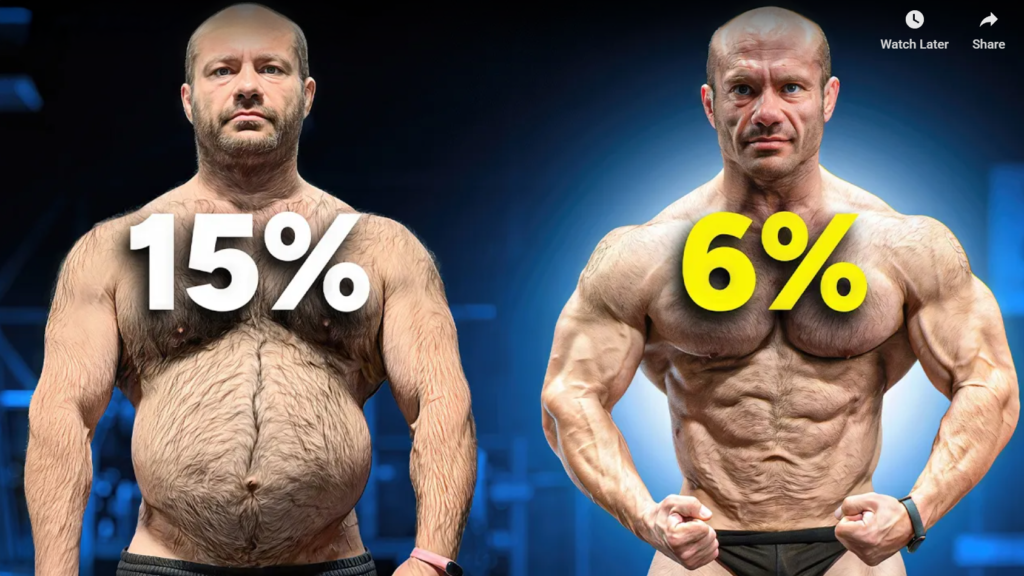
The Cut: How Dr. Mike Dropped Half His Body Fat
A clean, quote-led guide you can read once and reuse.
Timecoded quotes preserve trust and context. Action steps keep it practical.
Source: Dr. Mike (RP Strength) | Segments S1–S3 |
00:00:00
to
00:35:17
Video: https://www.youtube.com/watch?v=S8UfefiAwD8
How to use this (30 seconds)
- Read the quote. It anchors the claim.
- Read the takeaway. It tells you what matters.
- Do the micro-step. One action, zero overwhelm.
- If you only read one section, read The Formula That Never Fails.
Quick Jump (fast reference)
- 00:45 DEXA baseline: 15.6%
- 05:07 DEXA result: 6.00%
- 08:08 Deficit math: 2,800 cals, about 700 deficit
- 09:38 Protein: about 320g
- 15:50 Training split: pull, legs, push, rest (8-day cycle)
- 23:05 Fat loss training goal: stimulus to keep muscle
- 25:46 Steps: 10,000 is the unlock
- 29:32 Gear takeaway: more is overrated
- 33:50 The real formula: protein + deficit + steps + lifting
Proof (what changed)
“I have 15.6% body fat…” (00:45)
“DEXA scan had me at… exactly 6.00%.” (05:07)
The guide is built around measured checkpoints, not vibes.
Write down your current “starting line” measurement you trust. Even if it is just scale weight. (Today)
The timeline (why this worked fast)
“My first phase… about 11 weeks… roughly maintenance calories…” (03:23–03:43)
“…then… fat loss phase… about 15 weeks…” (04:44–05:07)
He did it in two clean phases: rebuild training first, then cut hard.
Pick your phase for the next 4 weeks: rebuild or cut. Write it at the top of your notes. (Today)
Phase 1: Recomp after downtime (the “easy gains” window)
“…off of training… number one thing… easiest gains… easiest fat loss…” (04:21–04:33)
If you are returning after a layoff, your body responds fast.
Start with “almost too easy” training for 2 weeks. Consistency beats hero workouts. (This week)
The deficit that did the work (simple math, executed daily)
“I ate an average of approximately 2,800 calories per day… the deficit… about 700ish…” (08:08–08:30)
Most of the fat loss came from a repeatable deficit, not tricks.
Track 3 days. Find your “real average.” Then subtract a small fixed amount. (Next 72 hours)
Protein as the anchor (hunger control plus retention)
“My average protein per day was about 320 gram…” (09:38)
“…it kept my hunger lower…” (10:34)
High protein makes the diet easier and helps keep lean tissue.
Add one protein-only item to your day before changing anything else. (Tomorrow)
Macros (what he actually ran)
“265 gram of carbs… and 50 gram of daily fats…” (10:40–10:53)
He kept fats low (because of exogenous hormones) and used carbs for training output.
If you are natural, do not copy the low-fat part blindly. Raise fats to a sane floor, then adjust calories. (This week)
Training split (built to recover while cutting)
“My split was roughly like this. A pull day, a leg day, a push day, and then a rest day… an eight day split…” (15:50–16:03)
The structure is simple and repeatable. It prioritizes recovery.
Pick a split you can repeat for 4 weeks without “reinventing.” Then stop changing it. (Today)
Training intensity in a fat loss phase (the mistake to avoid)
“What you need in a fat loss phase is… just enough of a stimulus to not lose muscle…” (23:05–23:19)
“A huge mistake… trying to get a lot stronger…” (23:19–23:35)
During a cut, your goal is muscle retention and performance maintenance, not PR hunting.
Set your cut goal: “Maintain strength” or “Small progression.” Write it in your training log. (Next session)
Micro-progressions (small adds win the cut)
“…micro progressions… two and a half pounds… are everything. It’s a huge unlock.” (24:05–24:25)
Tiny progress keeps you engaged without spiking fatigue.
Choose one lift and progress it by the smallest possible increment for 3 weeks. (This month)
Deload rhythm (fatigue management, not a vibe)
“A 3-day period for every 3 weeks is amazing…” (25:05–25:11)
“When you feel like you’re not kicking it… you take a quick deload…” (25:17–25:23)
He used frequent mini-deloads plus occasional longer deloads.
Put a deload marker on your calendar for 3 weeks from now. (Today)
The cardio that mattered (10,000 steps, sustainable)
“The number of steps… 10,000… this amazing unlock.” (25:46–26:12)
“Moderate high… 10,000–12,000 steps… golden ticket…” (26:24–26:31)
Consistent steps are high ROI and low complexity.
Pick your step method: treadmill, neighborhood, errands. Schedule one daily walk you can actually keep. (Tonight)
Competing demands (why he paused BJJ)
“Not doing BJJ… unlocked a huge amount of fatigue… competing demands… make your physique not as great…” (27:33–27:56)
Too many hard goals at once creates hidden recovery debt.
For 4 weeks, pick one primary goal: physique, sport, or performance. Then protect it. (Today)
The “elephant” (transparency and harm reduction)
“My lesson… taking a ton ton of gear is overrated…” (29:32)
“I think transparency is the ultimate teaching tool.” (29:45)
“Don’t copy people like me… don’t do anything dumb.” (30:07–30:13)
He is explicitly separating “what he did” from “what you should do.”
If you are tempted to copy drug protocols, stop and write a safer version: sleep, steps, protein, deficit, training. (Now)
Appetite and sleep (his pharma note, with a boundary)
“I use these substances to ease… hunger…” (32:56–33:07)
“These drugs massively improve my sleep…” (33:25)
“Talk to your doctor. Don’t ever do shit by yourself.” (33:36–33:43)
The claimed benefit is appetite control and recovery. The warning is explicit.
Start with the non-pharma version: high protein breakfast, earlier bedtime, steps after meals. (Tonight)
The formula that never fails (this is the keeper)
“Nothing beats consistency in a high protein, healthy calorie deficit diet with moderate to high activity, 10,000ish steps, and weight training regularly.” (33:50–34:03)
This is the core stack. Everything else is optional and secondary.
Build your “minimum effective day” using only these four pieces. Then repeat it 5 days this week. (This week)